

Algorithms structured to identify inherent clusters and associations without the guidance of pre-defined target variables.
Pattern
Discovery
Learning without an answer key. The engineering of grouping and simplifying complex, unlabeled data architectures.
Autonomous Modeling
In the absence of explicit labels, unsupervised learning operates on the principle of mathematical proximity. The system does not "predict" a known outcome; rather, it measures Euclidean distance, density gradients, and feature correlations to rebuild the internal geometry of a dataset.
Detect hidden structures, group similar observations, and map high-dimensional information into interpretable spaces for human or machine analysis.
Operates on raw features without supervisor intervention. Success is determined by internal coherence and statistical significance rather than accuracy scores.
Clustering
Methods
Centroid-based
The K-Means algorithm partitions data into K non-overlapping subgroups. It optimizes the minimum squared distance between points and their respective mathematical mean.
- High efficiency
- Global optimum focus
- Defined K-Parameters
Connectivity-based
Hierarchical Structure
Building a tree of clusters (dendrogram) using agglomerative or divisive strategies. This approach identifies recursive relationships across data depths.
- Nested Grouping
- No fixed clusters
- Linkage metrics
Density-based
DBSCAN Logic
Locating regions of high point density separated by areas of low density. Highly effective for isolating noise and identifying non-spherical geometric patterns.
- Outlier detection
- Arbitrary shapes
- No prior K-value
The Curse of Dimensionality
As feature sets expand, data points become increasingly sparse. This "volume explosion" masks meaningful patterns in noise. Dimensionality reduction compresses complex information while preserving the variance that defines the architecture of the signal.
Principal Component Analysis
Identifying the axes along which data shows the greatest variance—the "Eigenvectors"—and projecting points onto these planes.
Noise Filtering
By discarding low-variance components, algorithms eliminate redundant information and computational overhead.
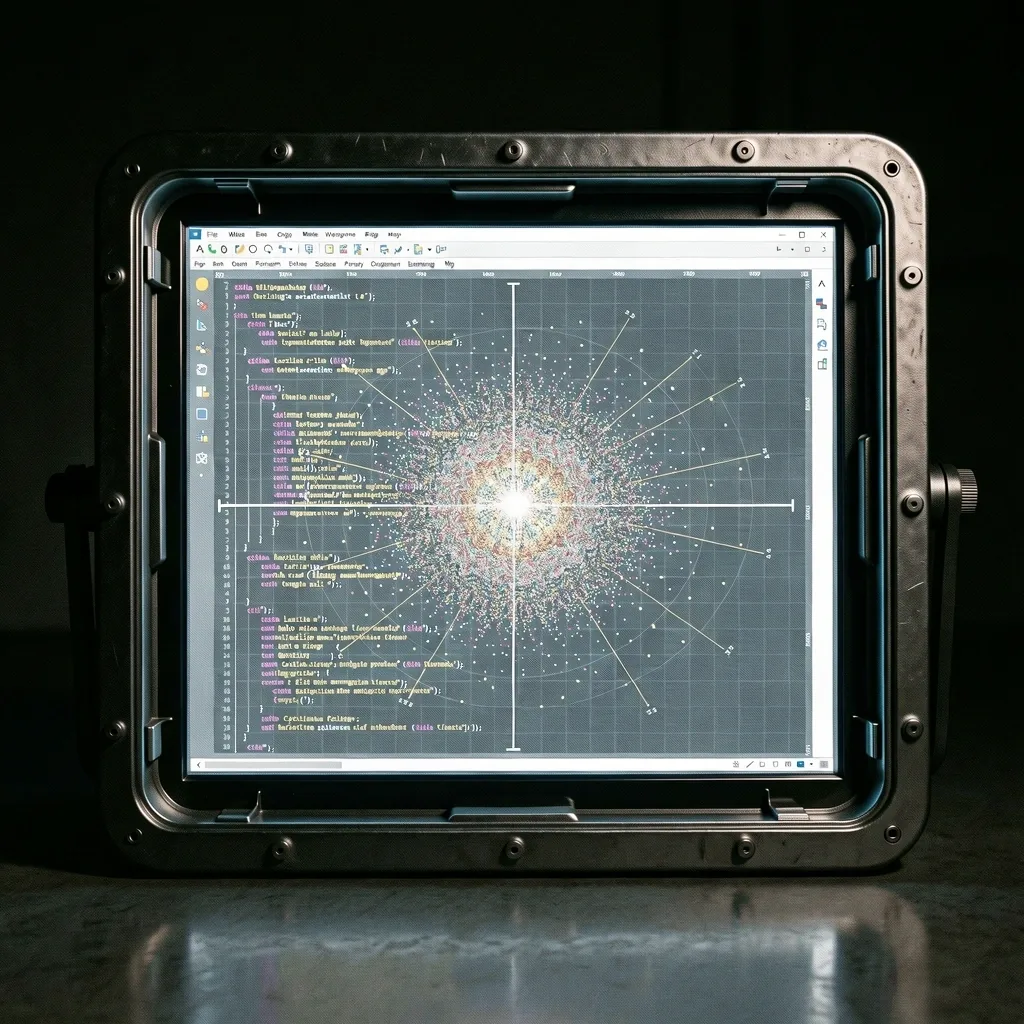
Dimensionality mapping: reducing feature complexity while maintaining 95% variance threshold.
Discovery
Constraints
"Pattern recognition is not causation. Without labels, the algorithm finds math, not meaning."
The subjective nature of unsupervised learning requires rigid statistical validation. Validating clusters requires silhouette scores and inertia analysis rather than binary truth markers.
Subjectivity Risk
Cluster assignment is highly sensitive to initial parameters and data scaling. Two identical datasets can yield vastly different groupings if the Euclidean distance is measured along un-normalized axes.
Validation Mechanics
Since ground truth is absent, reliability is measured through Silhouette Coefficients and the Elbow Method. If variance within clusters is high, the architectural logic of the model must be recalculated.

Refine Your
Architecture
Compare these patterns against established performance metrics.